


Tout va bien, tout va bien,
Petit tout va bien
02. 02. 2026
It’s getting real, folks. More and more people are talking to me about toying with the idea of moving out of the States.
Many folks are weighing their own well-being against what they feel are their obligations. Obviously, this is a personal decision – I can’t determine what the right balance is for someone else, but I don’t feel that fight and flight are mutally exclusive. I’m an unwavering “put your own mask on first” person – you’re simply no good to anyone if you’re passed out.
I can’t speak to anyone else’s situation but my own, of which I’m an expert. If you’ve read any of my other posts, it should be clear at this point that I believe to the very core of my being that we are here to do what feels authentic to us, to follow our own paths.
If you’re thinking about what it takes to do something that I’ve done on my path, and you think I might be able to answer questions you have about it, please reach out.
What does it really take to do a move like this – or other “big moves” in one’s life?
I want to write about something that folks have asked me about – or if not asked, have made a lot of assumptions about. I want to talk about what it took for me to get to France, and how much it cost me to get here / costs to live here.
I’m going to focus on moving to France, but if you’re contemplating doing something very different from what you’re doing now…
…parting ways with a partner
…leaving/losing the presumed security of a job
…going back to school
…a career pivot
…a big move
I’m inviting you to bring your aspirations, and your objections, down from the clouds a bit.
What might happen if you took the vision you have for your future life off a pedestal and at least pretended it’s possible?
…because it just might be.
SO WHAT?
I always like for there to be a point.
I don’t want to talk about what I did to make this move abroad just as an exercise in showing you how organized I am, or for you to copy me… I’m only as organized as I need to be, and I’m not the keeper or all knowledge (sadly).
I feel like it’s important to share because I’ve had so many folks tell me how brave I am when I do something big – what gets me is when they say, “I wish I could do that, but…”
And, I’m like, “…but what? You can.”
. . .
So, more than anything, I want to help knock down some of the stories that may be keeping you dreaming rather than doing – before life comes a-slapping.
To be clear, I get it – I’ve given a lot of power to the voice that says I don’t have enough time, money, knowledge, or strength to make something happen. She is so damned practical, she scares me into making decisions that are not always the best for me, and we’re not friends.
It’s taken practice to recognize how she dismisses my desires out of hand as she tells me why something isn’t possible. It’s taken a lot for me to stop automatically believing her.
What I’m going to share below is about telling that dumb voice to pipe down for a minute so you can hear yourself think.
AGE DOES NOT MATTER
I feel like this needs to be addressed.
Recently I had someone say they were too old to make a move abroad and I actually got excited hearing it, because that’s not a real excuse – it meant they could actually do it!
Why?
You are Never Too Old to be happy.
In fact, you’re Never Too Young to be happy.
People, I am 49.
Yes, I’m sacrificing my ego to let you in on that one…
I went back to get a PhD at 34, and you can bet that immediately after I even entertained the idea of exploring that path, I thought, “you’re too old.”
But my next thought was that the desire was never going to subside – I didn’t want it to. So, I could do the thing then and finish at 40, or I could go back later and finish even older.
The idea of losing time while I miserably toyed with doing what I wanted to do was far worse than just doing the thing.
. . .
I moved to France at 48.
I could have told myself I was too young, not yet retired – so why do you think you’ve earned this?
Or too old – it’s too late to restart your life in a foreign country.
In fact, I had thought both of these things at some point, which is why I didn’t have moving to France (at this time in my life) on my bingo card.
I will say that I’ve met people here who have moved from the US in the past few years or so ranging in age from their early 30s to their 70s. I’ve met three black women who’ve moved here just since the New Year.
These folks are working, not working, figuring out how to work, partnered, not partnered, unpartnering… and any other scenario you can think up.
. . .
I see it like this: it’s Now, Later, or Never.
Now: You’re the youngest you’ll ever be (cliché, but fact).
Later: You’ll just be older than your present “too old” self.
If you think you’re too old now, what does that mean for you in ten years? Are you planning to just lay down on your bed with your arms crossed solemnly across your chest, close your eyes, and do nothing?
WHAT DOES IT TAKE?
Okay, let’s get into some of the practical things I did to get here.
How do you even start to consider doing something like this?
Below are the steps that I’ve taken whenever I’ve made the leap from idea to possibility… and then reality.
1. You need to be open to the idea...
This is extremely important.
This first step means putting the voice that tells you you can’t make the move in the backseat, especially when it lists all of the reasons why you can’t with what seems like factually-based adult reasoning.
Adults are boring and often unhappy. Be like a child and keep asking, “Why?”
In my Getting Here post I talk about the thread of our stories, how something that seems like a decision out of the blue is most likely just a major plotline evolving. Recognizing any “big” idea you have shouldn’t be that much of a leap since it’s probably been rattling around in your mind for quite a while…
The hard part is being open to it.
This step is about giving your imagination a little air to breathe. How long can you sit and dream about what you want to do before you shut it down?
2. Look up Airfare
Okay, you don’t specifically have to look up plane tickets (yet), but you do need to know what it actually takes for you to do the thing.
I’ve mentioned this story before, but at 31 I’d never been anywhere outside of the US besides Canada…
One day I was literally bitching to myself about how folks without steady jobs could afford to travel the world – I was really salty about it, like I’d been cheated somehow.
And when I asked myself, “How do you know you can’t? Have you ever looked up flights to anywhere outside of the US?” I had to reply, “No… hadn’t thought of that.”
So, I got online and started looking up airfare to various destinations. Four months later I was in Belize, and it was awesome!
For me, the exploratory stage for France was happening at the same time I was giving the idea of moving to France free play in the back of my mind. If I think about it, I was actually in this stage for several years – the idea gaining reality with each thing I learned.
- I was consistently working on my language skills – because I enjoyed it, and I knew someday (in what I thought was the distant-ish future) I’d need it.
- I was taking in a lot of content from folks who had moved to France, learning about their experiences moving abroad and the steps they took to do it.
- I was considering what the actual cost of living there would be, and how much it might cost to get over there.
This demystified the whole process enough for the idea to quietly slip from mere idea to a partially-tangible possibility. Over the course of exploring this option I grew to feel increasingly confident that moving abroad was something I could do… when the time came.
Note that one doesn’t have to do all of the things I did, over the course of years, like I did them. It just took that time for circumstances to line up and for me to realize that the move was actually within reach.
3. Make the decision.
There’s really no daylight between “maybe” and “yes.” The jump from one to the other is marked by a significant, but immeasurable moment in time.
The line in the sand between my future plans when I opened my eyes on the morning I decided to move, and my future plans about ten minutes later was merely the decision to go.
Step two made this easy because I already knew what it would take for future-me to make the move – I just suddenly realized that present me already had what I needed.
Once I made the decision, the only thing left to do was to do it.
You may have heard folks talking about jumping timelines recently… that moment was a timeline shift for me. The future that had previously stretched out before me just seemed to disappear, and the new path became the only possibility.
4. Make Lists!
Once I’d made the decision, I immediately turned to the simplest and most comforting thing I could do – I listed every single thing I knew I’d need to do in the run up to my chosen departure day.
Why are lists so important?
They give you a sense of control and help you to break the steps up into smaller, more manageable segments.
This is essential to mitigating the overwhelm that will inevitably creep in at some point.
If I was going to freak out, I didn’t want to waste it on things like when to have my visa appointment – I found the melt-downs were better spent on deciding if I was going to hang on to my high school yearbooks.
Lists really did outsource some of my stress in giving me a sense of control. Instead of having a ticker of all the things I needed to do running through my mind, I knew that it was written down. If I missed anything, I could add it. I could go back and look at it with the satisfaction of being on-it as often as I wanted – and I did.
Past-me took on the role of present-me’s assistant.
That is why you need a list.
5. Create a Timeline
After I made my lists (list-makers know there’s always more than one), I took them and I made a timeline.
I have lists, why do I need a Timeline?
An illustrative aside: I was raised to believe that on time is late. I also don’t like to be rushed.
How did I reconcile these two things?
I taught myself to count backwards to make sure I have the wiggle room to get where I need to be, when I need to be there – without skidding in like Kramer.
If I need x amount of time to travel somewhere, then I want to leave with a buffer of x amount of minutes to make sure I’m on time. That also means that, counting backwards, everything I do up to that departure point needs to have its own allotted time and buffer. If I want to stare at the wall for ten minutes, which happens more often than not, I need to add that to the overall time it will take me to get out the door on time (and unruffled).
I applied the same framework to the move – I placed everything on the lists in the timeframe and order that they needed to be done, like a countdown.
This can ease a ton of stress as you realize that you don’t have to do everything at once.
In fact, there are some items you simply can’t check off until later in the process. If we take the getting out the door analogy here, consider that you have to put your underwear on before your pants.
It helps to know what’s your underwear and what’s your pants, so you don’t get spun-out about which to tackle first.
Below is a screenshot of my master checklist.
I had sub-checklists for things like completing my visa, packing, etc…

You may notice that there weren’t a lot of administrative things to attend to until about thirty days out, for which I was grateful.
The grunt work of getting piles of life organized and cleared can be physically and emotionally tiring. The list didn’t magically make packing, painting, and all of the other housekeeping things you see on my list less exhausting, but at least I knew what to zombie out and focus on.
Also, being able to check things off showed me I was making progress. I can’t overstate how this kept me going.
Two Things…
Thing One:
Folks may think this is a super organized approach and take that to mean they have to be on top of every detail – it can become a reason why they feel they can’t do it.
I disagree with that conclusion.
I like to think of the list and timeline as creating a way to be less on-it. Mapping out the things I was aware of allowed me to check out a bit and just do what I’d told myself to do.
The timeline put the little decisions about what to do this month, this week, or today on autopilot.
I could stumble groggily to my list – bedhead was my MO during this phase – and just see what boxes I needed to focus on checking that day. It also gave me the mental buffer to better manage whatever cropped up that I didn’t expect.
Thing Two:
I’ve had a number of people tell me they want to do x big thing, but they can’t… and the problem seems to be that they’ve made lists before they’ve made the decision.
I’m not here to tell anyone to make decisions without understanding what that decision means, especially not moving to a different country. But I will say that, more often than not, those lists are exactly what keep some folks from doing anything.
Making a list of what needs to be done before you decide to do the thing gives the naysaying voice all kinds of evidence for why you can’t do it.
In these cases, the list doesn’t become an accounting of incremental progress toward a goal, but an overwhelming estimation of all of the reasons why doing the thing is too hard.
So, I say to make the lists AFTER you’ve made the decision.
THE BUDGET
Knowing if you can move abroad financially sits somewhere in the space between idea and decision.
You can make the decision before you’ve locked in the numbers, but at least loosely knowing what’s possible financially often frees folks up to make the decision.
Let’s also keep in mind that you can make the decision years out from the actual move – if you need the time to budget and save, then your decision may not mean moving next quarter.
With that, I’ve found that folks have a huge misconception about what it costs to do this, and that tends to be the biggest reason I get when folks say, “We can’t, at least not for the next 10-plus years.”
Maybe that’s true, but the amount of money folks assume they need is often also based on looking at the future from the frame of the present.
Let me explain.
In the US, money drives every decision.
We carry a lot of anxiety about not having enough – for very good reason – and we also have idealized a lifestyle that is fueled by the need for a pile of expendable income.
Not sure where it came from, but the old magic number of $1M needed for retirement has been echoed enough to make anyone sick to their stomach about their future prospects.
I’m going to call BS on this assumption.
It is true that one probably needs that amount for healthcare and to continue their current lifestyle into their post-work years in the US, but what if the lifestyle you currently have isn’t the lifestyle of your dreams? What if you don’t have to plan for exorbitant living and healthcare costs?
If not, would you still kill yourself working until you’re 67 or older?
Let’s contextualize the budget around this question: Are you planning for the life you have or the life you want?
As I see it, the budget should be approached from two perspectives:
- The measurable cost of moving to/living outside of the US (what you have to spend).
- The lifestyle you aspire to (what you’ll want and, therefore, need to budget for).
MOVING COSTS
Below are three versions of a moving budget… My actual, and two other scenarios that illustrate average costs and may better represent someone else’s situation.


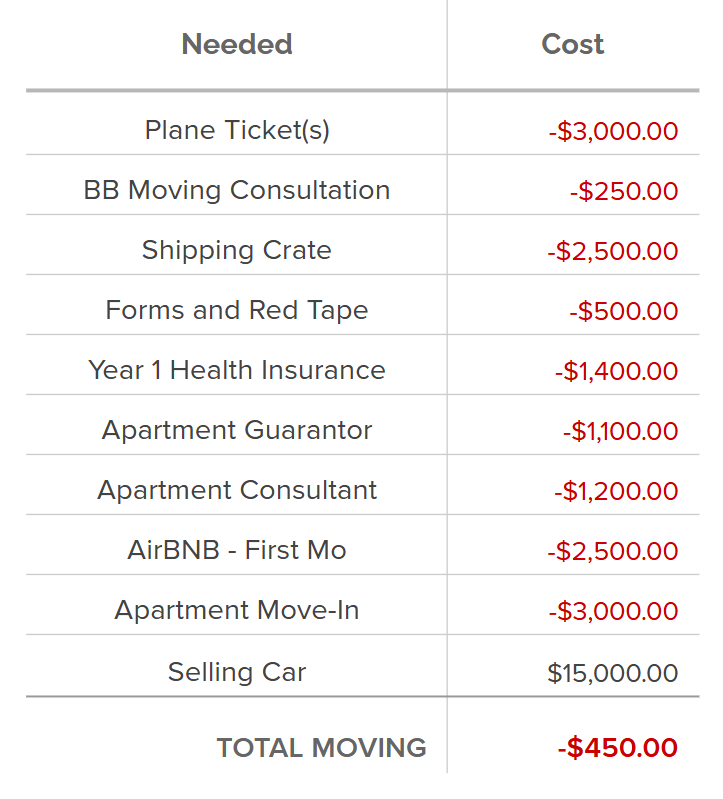
I ended up on the high end for a few things…
The first AirBNB was exhorbitant due to my last minute change, and the cats also figured into my overall options.
Note: I had a car to sell. It was a 2015 – not sexy, but a good car. That helped a lot!
This version accounts for more realistic costs, without pets figured into the equation, and shipping a moderate amount (not one’s whole past).
I kept the AirBNB number on the higher end for buffer.
I did leave in consultation and using a guarantor, I feel like they helped a lot.
If you don’t have pets, and you have a car to sell – which is probably newer than mine was and can be sold for more – you can practially offset your costs by selling your vehicle.
This is nowhere near exhaustive, it’s just to give you an idea. You can pick from the expenses above and tweak for you situation. Maybe you’ve got more to sell – even a home. Maybe you don’t want to use consultants – bravo!
Missing: Costs like getting my condo ready, cleaning, etc… I didn’t include these things as I did sell other items that essentially offset the investments I made in my property.
In the end, my biggest moving expenses really revolved around shipping, and my initial housing costs.
The cats changed what was available in terms of AirBNBs – especially thanks to the day-1 hole the wall incident – and that put a fire under my efforts to get into a long-term rental sooner.
I also could have done some things without the rental consultation and guarantor, but I felt I needed some backup after all of the work I’d put in. I was tired.
I’ll also caveat my shipping cost by admitting that I’m an outlier insofar as how much I kept and sent over – it was much more than average: about two rooms of furniture, Christmas decorations, my favorite housewares, a lot of books.
Most folks I’ve met have let go of almost all of their household items – brave souls!
While I understand that the above figures are not trivial, knowing what it (roughly) would cost means being able to budget for it. Maybe it means planning for a year or two out while you save a little every month.
About Housing…
When I first decided to move, I spent hours looking at what seemed like ridiculously affordable houses (and some not-so-affordable Chateaux) in the French countryside. I was enamored with the idea of buying a big house and renovating it… completely lost in the fantasy of how much I could get over here.
And then the fever broke.
I realized that, 1. I had no business moving directly out to the countryside when I needed to be immersed and get integrated, and 2. I was thinking with my American brain.
In the US, owning a home is a sign of wealth and stability. Owning is an investment that seems almost certain to increase in value, and it says something about one’s means and financial savvy.
In France, most folks buy homes to enjoy – for a very long time. Outside of Paris and some bigger cities, real estate does not necessarily move quickly, and home values do not swing broadly.
In short, buying is not automatically the best choice, and folks don’t judge others for renting.
I offer this for those who tell me they can’t afford to move yet on the assumption that they need to come over here and buy a house.
You do not.
In fact, not immediately doing so keeps your money liquid and offers the freedom to explore and find your place once in-country.
MONTHLY EXPENSES
Below is a rough monthly budget based on what I’m spending.
There’s a bit of wiggle room on either end of this as I know folks who are living well on up to €1k less each month, and very well on about €1k more.

I actually budget for about €3,000 per month as some months I travel more. That puts me at an even €36k per year.
Bordeaux is generally in the mid/higher end when it comes to rent and living costs in France. There are many areas in France, and in Spain and Italy, that require notably less for a good home in a nice community.
Not sure you’ve noticed, there is no car… I initially thought I’d get one, but I haven’t needed to. I can get wherever I want without one, and I can rent if I do need to go somewhere off of the train lines.
As a comparison to my past life…?
Mapping out my fixed monthly costs in the states, my expenses were conservatively about $3k more/mo – that includes health insurance. It also accounts for paying on credit cards, which I had no business using, and which aren’t much of a thing here the way they are in the US.
Generally, aside from large purchases, the mindset is to live within one’s current means. If you don’t have the money in the bank this month, you just don’t buy it.
I have to say, overall, that the monthly (and annual) cost of living here was a revelation for me – it changed everything I thought about what I need to have or earn going forward.
This takes us to the second budgetary consideration: Lifestyle.
Let’s just put aside that I moved here for a particular lifestyle, so of course it would be different. However, I didn’t realize how those differences would affect my cost of living.
Part of me expected to come here and live somewhat like I did in the states. I was thinking the way I did as a tourist – yay, everything is cheaper, I’m going to clean up!
Yes, cell service is way cheaper. Yes, I’m saving about $800/mo on insurance. Yes, the wine is much cheaper. Yes, high quality food costs less. Yes, going out to eat costs less. Tipping is the exception, not the rule, and leaving more than about 5% is just showing off – because of that I’ve saved hundreds since I’ve been here.
But it’s more than that…
In the states, if I was bored, I’d go shopping. If I felt like I was missing something, without giving it a second thought, I’d order it online and get it within 36 hours. In the US, my entertainment money went to over-priced meals, Ubers, filling my condo with stuff I didn’t even know existed until I saw it online or in some store, and cramming my closet with clothes I forgot to wear.
Point is, my monthly fixed costs didn’t account for all of the random stuff I’d regularly spend on. At the end of the day, I’d say an additional $1k consistently went unaccounted for in my monthly spending.
. . .
Here in France, it’s different.
I pause when I think about bringing another thing home, and I typically decide I don’t need it. Not because I’m on a budget, but because now, instead of getting a little hit from buying a new thing, acquiring more stuff feels like the last resort.
I don’t need special gear for every activity I try, I don’t need a new outfit for every mood, I don’t need more pretty dishes or pillows at home. Not just that I don’t need these things, I don’t want them the way I used to.
I am not a minimalist, it’s just generally the vibe here. One’s worth is decoupled from their financial means, and so having the things that in the states would signal one’s wealth doesn’t carry the same significance.
My life costs less here because I’m finding more fulfillment and joy in what I’m doing, not the trappings around those activities. A new pair of hiking boots doesn’t elevate the experience of hiking, and a leisurely walk to one of my preferred boulangeries only costs me a few euros for the bread and pastry I get there – note that no one notices that I wore the same jeans earlier that week.
In short, I’ve started spending on experiences rather than things – and it’s saving me money.
In this version of my life, the cost of the experience no longer has bearing on the lived-value of the experience.
So, again:
When you budget for your future life, are you looking at what it costs to maintain the lifestyle you have now, or the lifestyle you aspire to?
If you’re still here, I’m guessing the idea of moving abroad (or just living a different life) is enticing…
If moving somewhere you really want to be is a sincere desire for you, odds are more than 50% good that you actually can do it.
You are not too old.
You’re not too young.
If you’ve been on the “I need $1M to live” train for a while, then you can probably already afford to move.
The thing is, I’ve made every one of the path changes that l listed at the outset, and it’s likely most of you have also made some big pivots in your life. Some required a financial investment and planning, others simply required planning – they all required an emotional investment.
In each new endeavor we tackle, we can gain confidence in our ability to turn ideas into reality by remembering that we’ve done challenging things before.
… And, as I mentioned above, at times the environment has forced me forward…
Accidentally 49 now, I can tell you that the time does go quickly.
If you’re looking forward five years feeling like it’s forever away… don’t worry, it’s coming for you faster than you think!
Phew!
With that all said, this feels like a great place to drop some fodder for your plotting…
Below are some recent pictures – a couple of my apartment to see what I get for the cost.






Also, I want to share a few relevant content creators that I watch. They’ve helped me consider what a different version of my life could look like, how I could make it happen, and the ways in which it is still evolving.
I can’t say enough about how much they helped me prepare for the move. I watched their videos for months before I even decided to move, and I consulted with them to check my steps (which I made from their videos) when I was planning my move.
Adriel left her career as an attorney and moved to Paris solo during the pandemic. I enjoy watching her honest vlogs, and she helped me to think about what my daily life might be like here.
I started watching this channel after my move. Dr. Goobie was a neurosurgeon that left his career because it just wasn’t sitting right with him. His pivot and path resonate so much with me, and I really enjoy hearing his thoughts about the state of the world as he leans into the life he’s choosing.
I recently found Pearlieee, and she’s now my favorite! She’s chaotic, and each line either makes me laugh or think. Take this: “You are allowed to feel everything, but you should never feel like you’ve disappeared.”
This guy left the rat race several years ago. He decided he could live on his own terms, working when and where he wants, and enjoy himself – Now. He’s based in the US and primarily does seasonal work across various national parks, which keeps him in nature where he’s most content.
Stephanie is the co-creator of ExodUS Summit, and focuses specifically on empowering black folks to leave the US. Focusing on Mexico, South America, and Asia, she covers a lot of creative ways that folks can financially support a life abroad.
These folks help people find housing and get settled in France – I worked with them to get my apartment. They’ve recently started posting videos that I find to very insightful if France is the destination… I need to ask Ben who’s doing his writing, it’s first-rate.
6 Responses
Accidentally 49. lol!
It’s coming for you 😅
Love the lessons, wisdom and humanity in this blog. You have been such a help and gift. Thank you!
Thank You – thrilled you made the jump!
Love how thoughtfully this was written, really inspiring to read your story and appreciate the level of detail you went through here! That butter cookie also looks worth the move by itself!
I curse that cookie place every time I walk by… and then circle back to get one.